Talk With Me Baby: An infant speech development initiative giving Grady babies a stronger start 

Turning our safety net hospital into a “literacy safety net”
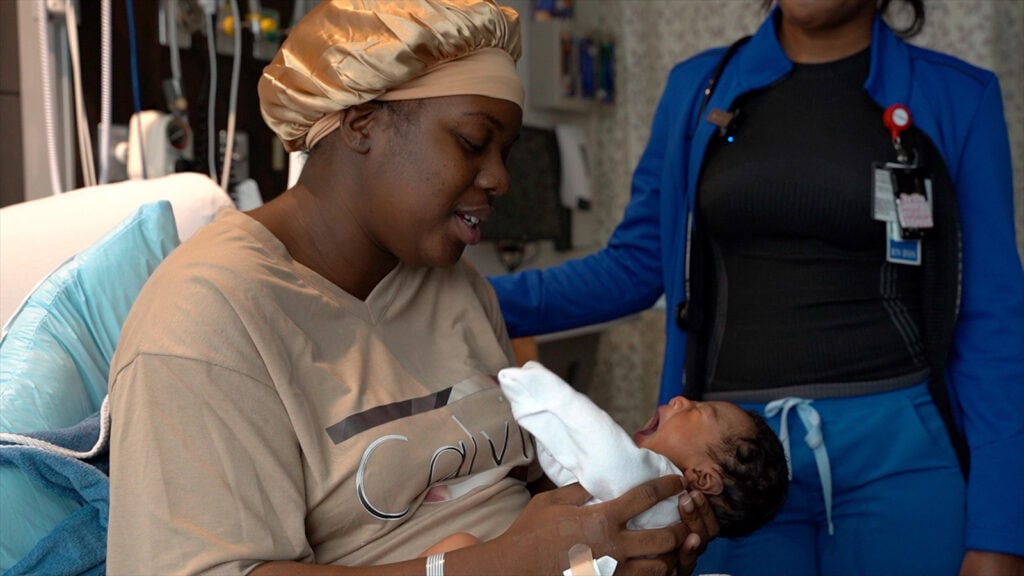
A mom talks to her newborn in Grady Hospital after being coached by a nurse on how it helps brain development.

“You’re going to wake up and show us your eyes? Look, you’re seeing everyone in this room. And soon you’ll be talking too.”

Holding her newborn son Shiloh at Grady Memorial Hospital, mom Ericka McIntosh is doing what generations of parents have done before her — she talks to her baby.

But this conversation is more important than you’d think. Her nurse has just explained that Shiloh isn’t simply hearing his mother’s voice. He’s learning important infant speech development cues from it that can impact him throughout his life.

Grady Hospital’s nationally recognized Talk With Me Baby program, made possible by United Way of Greater Atlanta, seeks to bridge persistent word gaps for the 2,600 babies born there each year. Now, being born a “Grady baby” is more than just a label claimed with hometown pride. It means starting life with a team dedicated to not only your healthcare, but also to helping build the foundation for infant learning, infant speech development, and literacy mastery.

Infant speech development: The word gap that grows

In Atlanta, where you’re born carries meaning — just ask any Grady baby and they’ll agree. But too often, it can also predict opportunity.

For years, early childhood researchers have documented what’s known as the “word gap,” the reality that children growing up in lower-income households hear 30 million fewer words than their more affluent peers by just three years old. Those differences often mirror the disparities we see in neighborhoods throughout our region in our Child Well-Being Index®, and can have long-lasting impacts on language development, school readiness, and academic achievement.

A mom and son read books in the ultrasound waiting room at Grady Hospital

At United Way of Greater Atlanta, we know that by the time a child is struggling to read in third grade, we’ve already missed years of opportunity, so our programs begin much earlier.

“Our goal is prevention versus intervention,” said Cori Dickens-Cain, Vice President of Strong Learners at United Way of Greater Atlanta. “We want families to have all of the skills, the agency, and the knowledge they need in the early years to set them up for when they enter school.”

Grady Hospital’s Talk With Me Baby program seeks to bridge that word gap from the very start of life, meeting families during one of the few moments that transcends ZIP code or income level: the birth of a child.

The birth of an idea for infant speech development

The program got its start through United Way of Greater Atlanta in 2013 at Dare to Forget the Box, a competition we hosted to encourage innovative solutions to some of Atlanta’s most pressing problems. A team from Atlanta Speech School’s Rollins Center for Language and Literacy and the Marcus Autism Center created a pitch based on the idea that parents don’t need special training or expensive tools to help their child’s brain development. They just need to use their voice. The concept won the competition and secured a multi-year grant to establish the program, but more importantly, it launched a partnership with United Way that continues today. Now, Talk With Me Baby serves as the front door to our larger Literacy and Justice for All program that helps families build strong language and literacy skills by the time a child reaches third grade.

“My brainchild was to create what I call a literacy safety net for our kids, just like Grady is a safety net hospital. I want a literacy safety net for our families — and Grady can’t do that by itself,” said Denise Mayhan, Director of Practice Operations at Grady Hospital and a founding leader of Talk With Me Baby.

Nursing staff at Grady Hospital act as Talk With Me Baby coaches, teaching new parents the importance of modeling conversations to encourage future literacy.
Nursing staff at Grady Hospital act as Talk With Me Baby coaches, teaching new parents the importance of modeling conversations to encourage future literacy.

In the last 13 years, more than 50,000 families have received research-backed training on how to help their child’s brain develop in a way that’s accessible regardless of income or background, simply by talking with them.

Most importantly, the results last. In an independent study of more than 1,400 Grady babies who went through the Talk With Me Baby program, the researchers found that years later, parents were still using language-building practices and children were tracking at or above age-level expectations for language development.

By ages four and five, only 2% of participating children demonstrated atypical behavior, significantly below national averages that often range from 15% to 20%.

“One of the things you look for with any intervention is, is it going to fade?” said Dr. Catherine Ayoub of the Brazelton Touchpoints Center in an interview with PBS. “But with Talk With Me Baby, there’s no fade.”

Infant learning: When care goes beyond a checkup

From prenatal visits to preschool, Talk With Me Baby helps transform routine healthcare interactions into coaching moments for families at Grady Hospital.

Families are introduced to the critical role of early language exposure at their first prenatal visits. Talking to babies goes beyond just parent-child bonding, actually helping to develop the language architecture in their brain during a critical time period for a child’s language development — and helps form their literacy trajectory years before even reaching the classroom.

In the mother-baby unit, certified medical assistants, nurses, and other care team members receive specialized training from Atlanta Speech School’s Rollins Center for Language & Literacy, equipping them not only to provide exceptional medical care, but also to model conversations with babies that support brain development.

The first Talk With Me Baby coaching moments begin at prenatal visits, where parents learn that talking with their infants can account for about 80 to 85 percent of baby’s brain development within the first three years of life.

The approach even extends to the NICU. While many hospitals have quiet intensive care units, where the sounds of monitors often outweigh the sounds of conversation, at Grady, the medical staff talk to even the smallest babies, knowing that even in medically serious conditions, the infants can benefit from language-rich interactions.

As children return for well-child visits, in Grady neighborhood health hubs in high-need neighborhoods, families receive additional books and parent resources on reading aloud, language development, and the building blocks of literacy. Most families receive between 12 and 15 coaching touchpoints, but some can receive as many as 40 to 50. That’s dozens of opportunities to strengthen language development during a child’s most critical years.

When babies talk back

“You’re probably wondering, how do you have a conversation with a baby? They’re not saying anything!” said Denise.

She explains that when you talk to your baby, you’ll sometimes see babies turn to look at you, wave their arms, or move their mouths — that’s their way of talking back to you. And the back-and-forth communication feeds their brain, connecting neurons that support learning. Ultimately, that brain development leads to babies’ first words, language development, and eventually, reading.

Language nutrition is equal to food nutrition in how important that is for your body, for brain development,” said Cori. “Even this brand new baby who is fresh out of your womb, there’s a benefit to talking to that baby. It’s helping the synapses in their brain connect and make meaning even from birth.”

From nursery to NICU, Grady babies across the hospital are receiving “language nutrition,” a flow of conversation that shows care and nourishes their brains.

Parents who have participated in the program have said that while it may feel strange at first, by the time they take the baby home from the hospital, talking to their baby throughout the day quickly becomes second nature.

“You know, they always say you always want to make eye contact, do skin to skin, and talk to them you know every now and then, but not on a regular basis to where it like develops their brain development. That was something new that I did not know,” mom Ericka said.

She said she can’t wait to see her son Shiloh begin to recognize her and his older brother’s voice after feeling him kick in the womb for so long — and based on how much she enjoys talking to him already, she knows they’re going to adjust well.

Literacy and infant speech development belong in a hospital

You may think literacy may not have a place in a medical setting. Hospitals deliver babies, and schools teach children how to read. But Talk With Me Baby exists because learning to read starts long before a child walks into a classroom.

Across Greater Atlanta, too many children enter elementary school a few steps behind — not because of anything they’ve done, but because opportunity isn’t distributed evenly. A child’s background can influence everything from access to early learning resources to the number of words they’ll hear in their earliest years. According to the Child Well-Being Index®, in neighborhoods with the lowest access to resources, only 1 in 5 children are strong readers by the time they reach 4th grade. By then, the gaps that began years earlier can be difficult to close.

Grady sees an opportunity to reach families during one of the most important windows of a child’s development, regardless of ZIP code or socioeconomic status.

If you cannot read and comprehend the spoken word, be articulate, and be able to learn on your own, you are at a significant disadvantage for being successful in life. That’s just the bottom line.

And so, with the understanding that so much of the brain architecture that enables a person to learn how to read and communicate is built from the third trimester of pregnancy to age three, to me, it says the health care system has to get involved. It can’t be left out of the process because we’re the only institution that I can think of that actually always touches the family during those times, prenatally and at birth. We’re the only institution that does that. If we can get it started there, what an impact, and we’re hoping that our work at Grady will spread.”

– Denise Mayhan

Today, Talk With Me Baby is helping create a future in which where a child is born is a source of possibility, not a limiter. Because Atlanta’s pride in its Grady babies has never really been about the place — it’s about who they become. And with a strong foundation, those babies can grow up to become the next leaders, teachers, nurses, and beyond.

Your gift to United Way of Greater Atlanta helps support programs like Talk With Me Baby that put health access, literacy, and opportunity in reach for children and families across our region. Help make an impact when you donate today.

"*" indicates required fields

This field is for validation purposes and should be left unchanged.
Name*
10 digits only
Do you agree to receive recurring texts from United Way of Greater Atlanta? Message frequency may vary. Standard message and data rates may apply based on your mobile plan.*

Thank you !

“You’re going to wake up and show us your eyes? Look, you’re seeing everyone in this room. And soon you’ll be talking too.”

Holding her newborn son Shiloh at Grady Memorial Hospital, mom Ericka McIntosh is doing what generations of parents have done before her — she talks to her baby.

But this conversation is more important than you’d think. Her nurse has just explained that Shiloh isn’t simply hearing his mother’s voice. He’s learning important infant speech development cues from it that can impact him throughout his life.

Grady Hospital’s nationally recognized Talk With Me Baby program, made possible by United Way of Greater Atlanta, seeks to bridge persistent word gaps for the 2,600 babies born there each year. Now, being born a “Grady baby” is more than just a label claimed with hometown pride. It means starting life with a team dedicated to not only your healthcare, but also to helping build the foundation for infant learning, infant speech development, and literacy mastery.

Infant speech development: The word gap that grows

In Atlanta, where you’re born carries meaning — just ask any Grady baby and they’ll agree. But too often, it can also predict opportunity.

For years, early childhood researchers have documented what’s known as the “word gap,” the reality that children growing up in lower-income households hear 30 million fewer words than their more affluent peers by just three years old. Those differences often mirror the disparities we see in neighborhoods throughout our region in our Child Well-Being Index®, and can have long-lasting impacts on language development, school readiness, and academic achievement.

A mom and son read books in the ultrasound waiting room at Grady Hospital

At United Way of Greater Atlanta, we know that by the time a child is struggling to read in third grade, we’ve already missed years of opportunity, so our programs begin much earlier.

“Our goal is prevention versus intervention,” said Cori Dickens-Cain, Vice President of Strong Learners at United Way of Greater Atlanta. “We want families to have all of the skills, the agency, and the knowledge they need in the early years to set them up for when they enter school.”

Grady Hospital’s Talk With Me Baby program seeks to bridge that word gap from the very start of life, meeting families during one of the few moments that transcends ZIP code or income level: the birth of a child.

The birth of an idea for infant speech development

The program got its start through United Way of Greater Atlanta in 2013 at Dare to Forget the Box, a competition we hosted to encourage innovative solutions to some of Atlanta’s most pressing problems. A team from Atlanta Speech School’s Rollins Center for Language and Literacy and the Marcus Autism Center created a pitch based on the idea that parents don’t need special training or expensive tools to help their child’s brain development. They just need to use their voice. The concept won the competition and secured a multi-year grant to establish the program, but more importantly, it launched a partnership with United Way that continues today. Now, Talk With Me Baby serves as the front door to our larger Literacy and Justice for All program that helps families build strong language and literacy skills by the time a child reaches third grade.

“My brainchild was to create what I call a literacy safety net for our kids, just like Grady is a safety net hospital. I want a literacy safety net for our families — and Grady can’t do that by itself,” said Denise Mayhan, Director of Practice Operations at Grady Hospital and a founding leader of Talk With Me Baby.

Nursing staff at Grady Hospital act as Talk With Me Baby coaches, teaching new parents the importance of modeling conversations to encourage future literacy.
Nursing staff at Grady Hospital act as Talk With Me Baby coaches, teaching new parents the importance of modeling conversations to encourage future literacy.

In the last 13 years, more than 50,000 families have received research-backed training on how to help their child’s brain develop in a way that’s accessible regardless of income or background, simply by talking with them.

Most importantly, the results last. In an independent study of more than 1,400 Grady babies who went through the Talk With Me Baby program, the researchers found that years later, parents were still using language-building practices and children were tracking at or above age-level expectations for language development.

By ages four and five, only 2% of participating children demonstrated atypical behavior, significantly below national averages that often range from 15% to 20%.

“One of the things you look for with any intervention is, is it going to fade?” said Dr. Catherine Ayoub of the Brazelton Touchpoints Center in an interview with PBS. “But with Talk With Me Baby, there’s no fade.”

Infant learning: When care goes beyond a checkup

From prenatal visits to preschool, Talk With Me Baby helps transform routine healthcare interactions into coaching moments for families at Grady Hospital.

Families are introduced to the critical role of early language exposure at their first prenatal visits. Talking to babies goes beyond just parent-child bonding, actually helping to develop the language architecture in their brain during a critical time period for a child’s language development — and helps form their literacy trajectory years before even reaching the classroom.

In the mother-baby unit, certified medical assistants, nurses, and other care team members receive specialized training from Atlanta Speech School’s Rollins Center for Language & Literacy, equipping them not only to provide exceptional medical care, but also to model conversations with babies that support brain development.

The first Talk With Me Baby coaching moments begin at prenatal visits, where parents learn that talking with their infants can account for about 80 to 85 percent of baby’s brain development within the first three years of life.

The approach even extends to the NICU. While many hospitals have quiet intensive care units, where the sounds of monitors often outweigh the sounds of conversation, at Grady, the medical staff talk to even the smallest babies, knowing that even in medically serious conditions, the infants can benefit from language-rich interactions.

As children return for well-child visits, in Grady neighborhood health hubs in high-need neighborhoods, families receive additional books and parent resources on reading aloud, language development, and the building blocks of literacy. Most families receive between 12 and 15 coaching touchpoints, but some can receive as many as 40 to 50. That’s dozens of opportunities to strengthen language development during a child’s most critical years.

When babies talk back

“You’re probably wondering, how do you have a conversation with a baby? They’re not saying anything!” said Denise.

She explains that when you talk to your baby, you’ll sometimes see babies turn to look at you, wave their arms, or move their mouths — that’s their way of talking back to you. And the back-and-forth communication feeds their brain, connecting neurons that support learning. Ultimately, that brain development leads to babies’ first words, language development, and eventually, reading.

Language nutrition is equal to food nutrition in how important that is for your body, for brain development,” said Cori. “Even this brand new baby who is fresh out of your womb, there’s a benefit to talking to that baby. It’s helping the synapses in their brain connect and make meaning even from birth.”

From nursery to NICU, Grady babies across the hospital are receiving “language nutrition,” a flow of conversation that shows care and nourishes their brains.

Parents who have participated in the program have said that while it may feel strange at first, by the time they take the baby home from the hospital, talking to their baby throughout the day quickly becomes second nature.

“You know, they always say you always want to make eye contact, do skin to skin, and talk to them you know every now and then, but not on a regular basis to where it like develops their brain development. That was something new that I did not know,” mom Ericka said.

She said she can’t wait to see her son Shiloh begin to recognize her and his older brother’s voice after feeling him kick in the womb for so long — and based on how much she enjoys talking to him already, she knows they’re going to adjust well.

Literacy and infant speech development belong in a hospital

You may think literacy may not have a place in a medical setting. Hospitals deliver babies, and schools teach children how to read. But Talk With Me Baby exists because learning to read starts long before a child walks into a classroom.

Across Greater Atlanta, too many children enter elementary school a few steps behind — not because of anything they’ve done, but because opportunity isn’t distributed evenly. A child’s background can influence everything from access to early learning resources to the number of words they’ll hear in their earliest years. According to the Child Well-Being Index®, in neighborhoods with the lowest access to resources, only 1 in 5 children are strong readers by the time they reach 4th grade. By then, the gaps that began years earlier can be difficult to close.

Grady sees an opportunity to reach families during one of the most important windows of a child’s development, regardless of ZIP code or socioeconomic status.

If you cannot read and comprehend the spoken word, be articulate, and be able to learn on your own, you are at a significant disadvantage for being successful in life. That’s just the bottom line.

And so, with the understanding that so much of the brain architecture that enables a person to learn how to read and communicate is built from the third trimester of pregnancy to age three, to me, it says the health care system has to get involved. It can’t be left out of the process because we’re the only institution that I can think of that actually always touches the family during those times, prenatally and at birth. We’re the only institution that does that. If we can get it started there, what an impact, and we’re hoping that our work at Grady will spread.”

– Denise Mayhan

Today, Talk With Me Baby is helping create a future in which where a child is born is a source of possibility, not a limiter. Because Atlanta’s pride in its Grady babies has never really been about the place — it’s about who they become. And with a strong foundation, those babies can grow up to become the next leaders, teachers, nurses, and beyond.

Your gift to United Way of Greater Atlanta helps support programs like Talk With Me Baby that put health access, literacy, and opportunity in reach for children and families across our region. Help make an impact when you donate today.

Thank you for contacting us.
We have received your message and will get back to you shortly.

Stay Connected

"*" indicates required fields

This field is for validation purposes and should be left unchanged.
Name*
10 digits only
Do you agree to receive recurring texts from United Way of Greater Atlanta? Message frequency may vary. Standard message and data rates may apply based on your mobile plan.*

Thank you for contacting us.

We have received your message and will get back to you soon!