
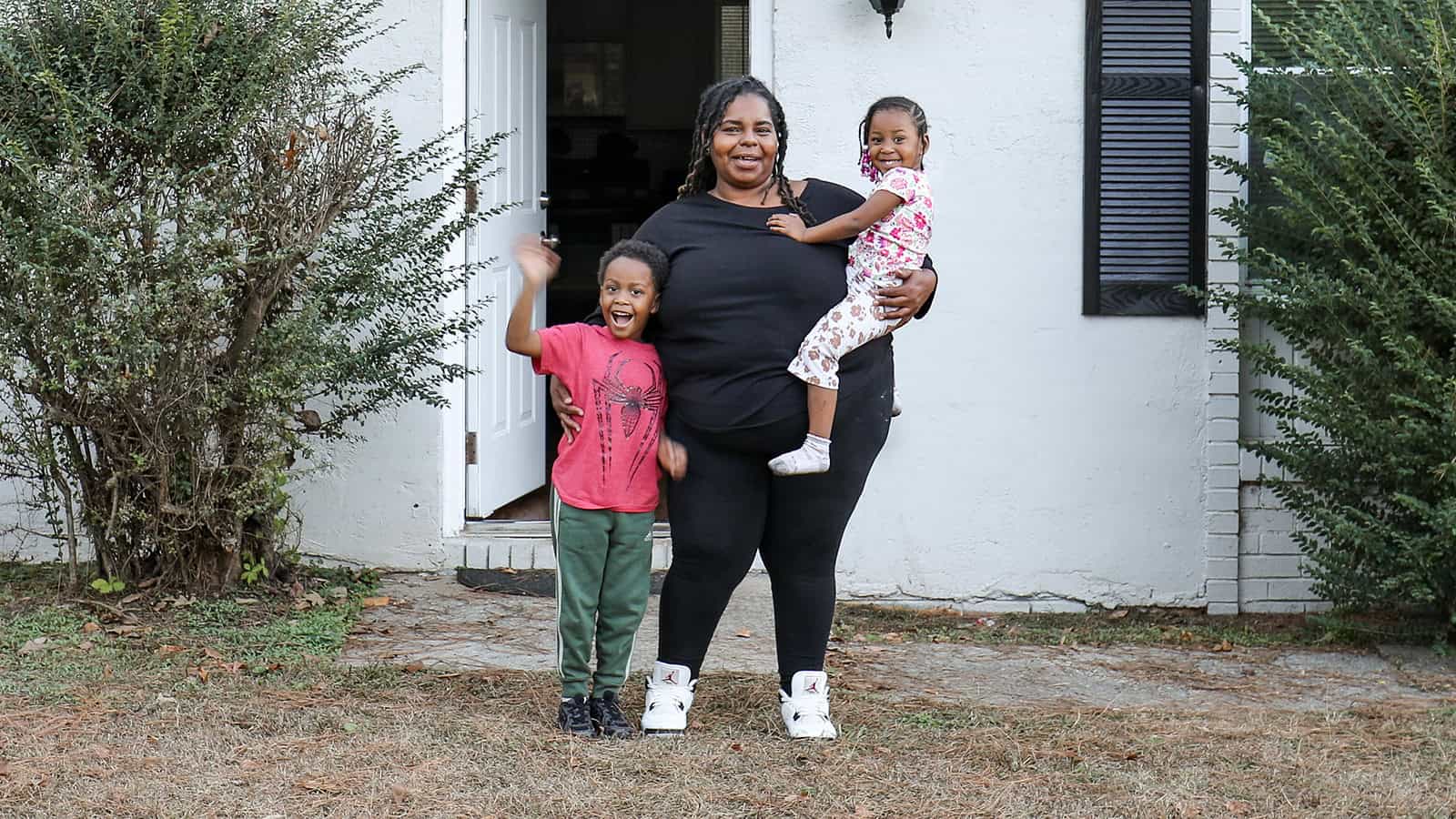
Taquana is the heart of her family, the one who brings everyone together. Holidays? They’re hosted at her house. When the grandkids need a place to play this weekend, her doors are always open. Where her older children want to go out with friends? They gather first at her house. She lives with the youngest two of her four children, ages 16 to 30, her aunt, and, on weekends, the joyful chaos of grandkids. For her, home means family.
That sense of home became harder to hold onto after an eviction. For two years, Taquana and her family faced housing insecurity, moving between relatives’ spare rooms and a hotel.
“Stability is the top priority. For a while, I thought it was going to take us a really long time to get out of the hotel, because of trying to pay it weekly, while paying bills, and gas,” said Taquana. “For a while, we were driving 150 miles a day to get between work, the hotel, and my daughter’s school.”
When Taquana’s daughter began enrollment paperwork for eleventh grade without a home address, the school counseling staff reached out to United Way of Greater Atlanta’s Kids Home Initiative for help.
Through our Kids Home Initiative, we partner with school social workers to identify students experiencing housing insecurity, whether they’re staying in motels, crashing on a friend’s couch, or living in cars or on the street. Together with housing partners like Frontline Housing, Community Restoration Project, and Single Parent Alliance and Resource Center, we help families transition into permanent housing while ensuring their children’s education continues uninterrupted.
>>RELATED: From Homelessness to Helping Others
When housing insecurity follows students to school
We recently expanded Kids Home to Henry County, where Taquana’s daughter attends school. According to school social worker Denitra Miller, there has been an increase of housing insecurity in the district, with numbers climbing each year since 2023. This year, since August alone, the Henry County school system has identified more than 800 students experiencing homelessness, and she hears of more each week.
“A lot of our homeless students don’t look like your typical homeless person,” explained Ms. Miller. “Most times people think of homelessness as out on the streets, where you can see them. But we often have our children that are homeless because they don’t have an adequate place to live, or they’re doubled up, meaning that they live with relatives. So just those frequent moves from shelters to hotels, or with relatives—it just causes instability.”
A child experiencing homelessness could move several times throughout the school year. And with that type of housing insecurity, the school counseling team often sees increased absences, mental health concerns, and an impact on academic performance.
For Taquana’s daughter, a sixteen-year-old who loves her science classes and dance team, that was certainly the case.
“It definitely took tolls on her grades. She was struggling, barely even wanting to go to school while we were in transition,” said Taquana.
According to the latest PIT data, while the overall rate of homelessness stayed constant in Atlanta, family homelessness rose 14% this year. We’re also seeing in our work that the chronicity and intensity of these caught in the housing instability cycle is increasing.
18,000 students in the thirteen county Greater Atlanta region experienced homelessness last year according to the Georgia Department of Education. On average, that’s one student on every school bus you see.
Serving up stability, one student at a time
Ideally, for financial stability, families should spend about 30% of their household income on housing according to the U.S. Department of Housing and Urban Development. But right now, due to the unaffordability of housing costs in our region, for many families it’s reaching 50% or even 70% or 80% of their income—once rent is paid, there is no money left.
“Once that happens, then comes the tough decisions, like do I have access to a food pantry? Do I get medicine this month? At that point, there are definitely no field trips or anything like that,” said Rorie Scurlock, Vice President of Economic Stability. “Families are not even living check-to-check. The check is expended before the next one comes.”
Thankfully, Taquana was able to find a home with a landlord who was willing to work with her despite her previous eviction.
United Way of Greater Atlanta’s Kids Home Initiative and Frontline Housing covered Taquana’s security deposit and move-in fees for a three-bedroom home in Jonesboro—something that felt impossible with the expenses of living in a hotel week-to-week. Today, she has more than a roof over her head. Taquana has a space where family can gather in at last.
When she asked her grandkids what they liked about grandma’s new house, they pointed out the nightlights, a new bed, a big kitchen, a refrigerator with a water dispenser, and even ran back and forth the length of the open floorplan living room to show how much space there was.
“I hope this teaches my kids that stability is important. I also want them to remember that we are resilient. Anything, we can always get through it, especially if we’re together.”
“By bringing United Way of Greater Atlanta’s Kids Home Initiative to the Southern Crescent, specifically to Henry County, in partnership with our stakeholders, we can break cycles of housing insecurity, strengthen families, and lay the foundation for long-term success,” said Jennifer Young, Regional Director of the Southern Crescent.
We are excited to continue to build partnerships and relationships with different housing partners and school systems throughout our region. However, we rely on the support of our community in order to help break the cycles for families like Taquana’s. You can give the gift of stability when you donate today.