
You may know schools as places of learning, but they’re also a source of food, counseling, child care, extracurricular activities, and health resources. For thousands of kids across our region, summer isn’t just a break from school — it’s a break from stability.
From free summer meals to day programs for teens and kids, communities and organizations like United Way of Greater Atlanta work together to address support gaps that widen in summer.
While kids across Greater Atlanta may face boredom or search for ways to beat the heat, challenges for kids in neighborhoods with fewer resources will run deeper. Here are some of the top challenges children face during the summer months.
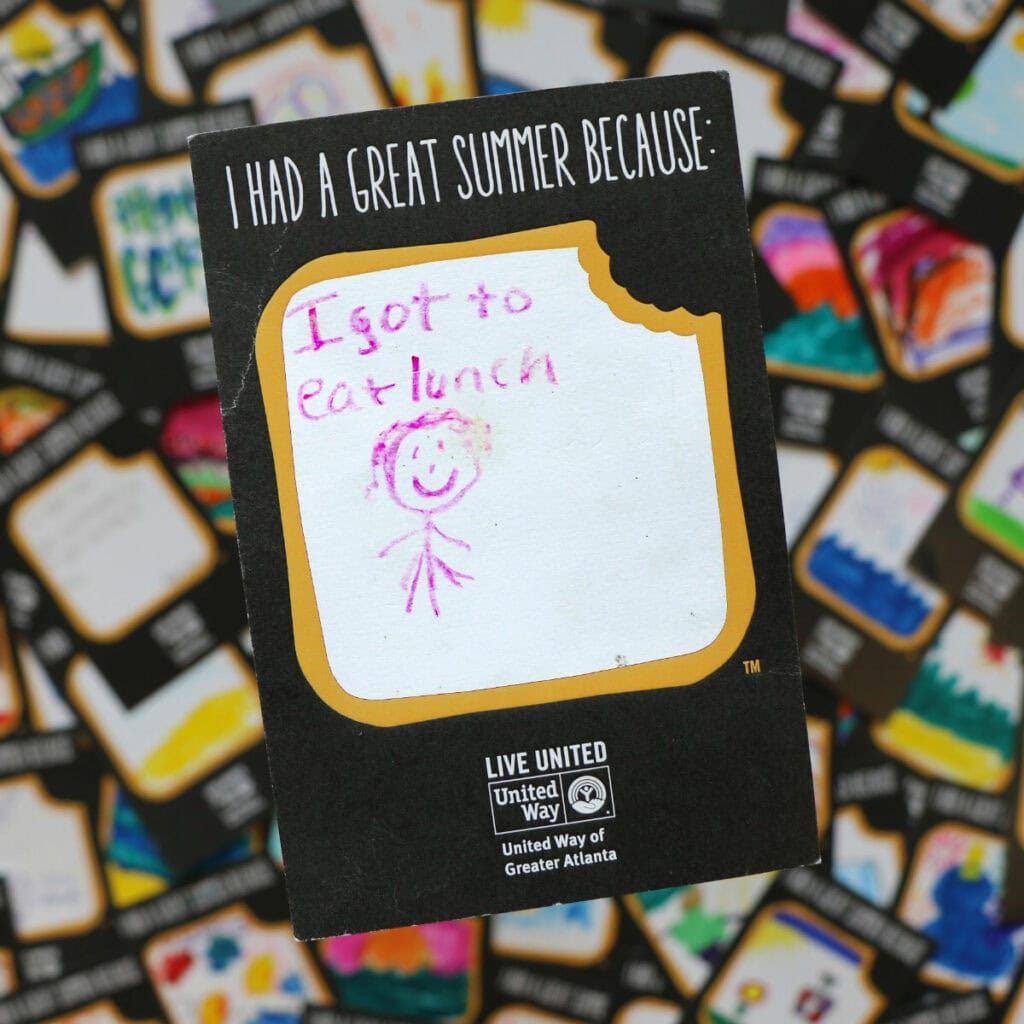
1. Summertime food insecurity
Serving breakfast, lunch, and sometimes a snack too, public schools are often a family’s most reliable food source. In fact, 45% of students in Greater Atlanta face the daily possibility of missing a meal when they should be enjoying their summer break.
Here’s the good news: all kids across Georgia are eligible for free summer meals through DECAL’s free summer food program, regardless of whether they’re enrolled in a school, income, or citizenship status.
You can find the free summer food program closest to you here.
United Way of Greater Atlanta also will continue to offer our school-based farmers markets in certain Title I elementary schools alongside Community Farmers Markets throughout the summer, so kids have access to nutritious, in-season fresh food as well.
>> LEARN MORE: Mini farmers markets arrive at APS Schools
2. Limited access to enrichment
During the school year, kids gain exposure to art, music, P.E., science, languages, and often a whole host of afterschool sports and activities as well. When the school year ends, summer camps offer the chance to extend these enrichment activities, creating social skills, physical skills, and the chance to build curiosity with new activities. But those camps can be cost-prohibitive for lower-income families.
Some research has found that these kids are less likely even to participate in free activities like going to the park, and this can lead to loneliness and mental health challenges at the start of school.
We know how important that is for our youngest learners especially, which is why many of United Way of Greater Atlanta’s programs, like Learning Spaces, our free community preschool program, run through the summer months in DeKalb, Cobb, Douglas, and Fulton. Clayton County Learning Spaces will be open in June.
3. Summer Slide
“Summer slide” refers to learning loss that takes place over the summer months during an extended break from formal classroom instruction. Some research shows that this loss is more clearly felt by children from lower socioeconomic backgrounds, possibly due to the “faucet theory.”
Kids attending school have access to similar resources during the school year — meals, supportive adults, learning experiences — no matter their income or background. When the summer months come, those resources for lower-income kids turn off, like a faucet. Meanwhile, kids from higher-income families still have the same access through paid camp experiences, Wi-Fi, and their parents’ ability to take kids to programs or read to their kids over the summer. For these kids, the faucet of support always stays on.
And the discrepancies can sometimes be seen when it’s time to come back to school in the fall and go into standardized testing. According to Learn4Life, students from poorer backgrounds score, on average, 43 percentage points lower on 3rd-grade reading, an important predictor of future school success. There are lots of reasons, but a lack of resources and the “summer slide” that follows could be a part of the problem.
>> LEARN MORE: Equity and Justice through universal literacy
4. Child care gaps
For many Greater Atlanta families, the gap between child care costs and what parents can afford is growing, both in the cost of care and in the cost of missed work. According to the Annie E. Casey Foundation, in 66% of families with school-age children, both parents work. When kids are home from school during summer break, families lose more than 30 hours a week of structured, supervised care for their children. Coordinating transportation and the costs of summer programs only adds to the burden.
The City of Atlanta Parks and Recreation department is offering free or scholarship-funded camp opportunities for teen day programs to keep youth engaged during summer months. School-based day programs for teens offer students a chance to strengthen their academics and remain connected to their community during the summer. The YMCA of Metro Atlanta also hosts summer camps with financial hardship scholarships available. United Way of Greater Atlanta also partners with Atlanta Public Schools to put on free kindergarten readiness camps for young learners.
5. Environmental safety
One final gap in support facing Greater Atlanta kids during the summer months is heat-related safety concerns. Year after year, United Way of Greater Atlanta’s 211 Contact Center sees an increase in requests for utility assistance during hot months — and living without air conditioning can be a critical issue for a child’s health and well-being. Heat waves kill more on average than any other type of weather in the United States, according to a report from the CDC.
We connect 50,000+ families a year to power and gas bill assistance to prevent shutoffs. If you and your family are in need of utility assistance, please text “utility assistance” and your zip code to 898-211.
From free summer food programs to learning opportunities to utility assistance, United Way of Greater Atlanta and our network of partners are here to help. When school doors close, the needs don’t disappear. They shift to neighborhoods, to families, and to all of us. You can help fill the gaps this summer by donating today.